GitHub star history in 2026: what changed, and how to show it

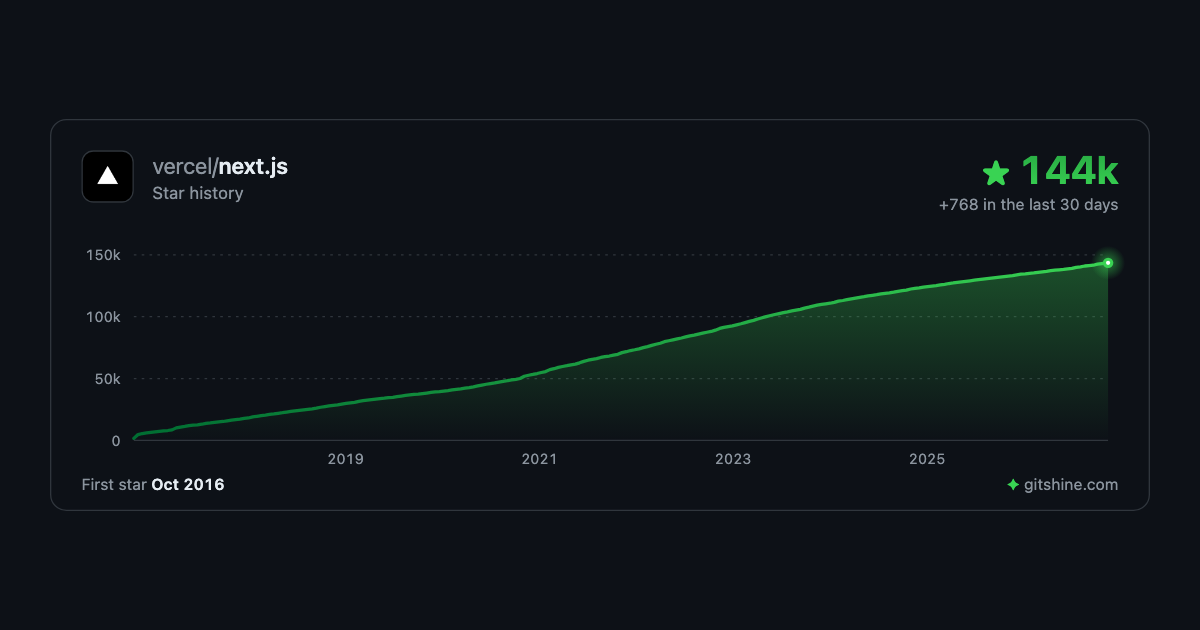
If a star history chart in your README went blank this summer, GitHub changed how star data can be read. Star counts are still public. The list of who starred a repository isn't, and that list is what most star history charts were built from.
The short answer
- June 30, 2026: GitHub limited the stargazers list (the
/repos/{owner}/{repo}/stargazersendpoint and the Stargazers page) to a repository's admins and collaborators. Everyone else gets nothing back. - September 4, 2026: GitHub added a star history endpoint,
GET /repos/{owner}/{repo}/stargazers/history, with daily star counts for any public repository back to its creation, and no stargazer identities. - To show star history in a README today, use a chart built on the new endpoint, like GitShine's star history card.
What changed on June 30
GitHub's changelog announced that the stargazers list, and the watchers list with it, would only be visible to people who can administer or edit the repository. GitHub's reason was abuse: bots were scraping the lists for usernames to target spam at.
In practice, this is what you see now with a token that has no access to the repository (we checked this week):
- The REST endpoint answers 404 Not Found.
- GraphQL's
stargazersconnection returns no edges, thoughstargazerCountis still there. - On your own repositories, both work as before.
What broke
Star history charts used to page through the stargazers list, which carries each star's date, and draw the running total. Without the list, those charts can only be drawn by the repository's own admins. Star History's post described exactly that: charts for repositories you don't own stopped working, including live charts embedded in READMEs.
The new star history endpoint
On September 4, GitHub shipped a privacy-safe replacement: star counts over time, without saying who starred.
curl -H "Authorization: Bearer $GITHUB_TOKEN" \
     -H "X-GitHub-Api-Version: 2026-03-10" \
"https://api.github.com/repos/OWNER/REPO/stargazers/history?per_page=30&page=1"What comes back is a list of weeks, newest first:
[
  { "week": 1794096000, "total": 119, "days": [25, 32, 27, 16, 19, 0, 0] },
  { "week": 1793491200, "total": 245, "days": [18, 30, 21, 75, 38, 21, 42] }
]daysis the stars created on each day of that week, Sunday first.totalis their sum. In our calls,weekwas the Unix time of the week's Sunday.- A page holds up to 30 weeks. Pages go back toward the week the repository
was created, and the
Linkheader says how many there are, so a ten-year-old repository is about 18 requests. - Add up the weeks from the oldest and you have the curve. The sum can be a little off today's star count, because people also unstar. Scaling the curve to the current count fixes that.
- It answers even without a token, within GitHub's limit of 60 anonymous requests an hour. Any token raises that limit: a fine-grained personal access token works, and it doesn't need any access to the repository.
A star history chart in your README
GitShine's star history card is built on the new endpoint. Replace OWNER
and NAME:
[](https://gitshine.com/cards?repo=OWNER/NAME)It draws stars from the first one to today, with the total and the stars
gained in the last 30 days, and it updates every hour. It follows each
visitor's light or dark mode, or you can fix a theme with ?theme=dark,
light, night, dracula and more. There's no token to create and nothing to
host. Star History says its own charts work again since September too, so
use whichever chart you like.
The same page has two more cards for a project README:
- Contributors: the avatars of the people who built it, most commits
first:
https://gitshine.com/contributors/OWNER/NAME. GitHub's contributors list is still public. - Repository: stars, the description and a year of weekly commits:
https://gitshine.com/repo/OWNER/NAME.
See all three, live for your repository, in the card gallery.
If you build your own chart
- Ask for page 1 first and read the last page number from the
Linkheader, then fetch the rest in parallel. - Cache the result. The history only changes at the recent end, so a few hours is fine.
- Don't fall back to the stargazers list for other people's repositories. It only works for repositories you administer.